ExoIris: Easy Exoplanet Transmission Spectroscopy#




Overview#
ExoIris is a Python package for exoplanet transmission spectroscopy that models full 2D spectroscopic transit time series directly, estimating self-consistent transmission spectra with uncertainties. It supports joint multi-instrument, multi-epoch analyses with flexible spectral resolution, Gaussian process noise models, transit timing variations, spot-crossings, and inclusion of the transit light source effect.
A complete analysis, including optimization and MCMC sampling, typically takes minutes to tens of minutes, though the most complex multi-instrument analyses may take up to a few hours. See the feature overview below for details.
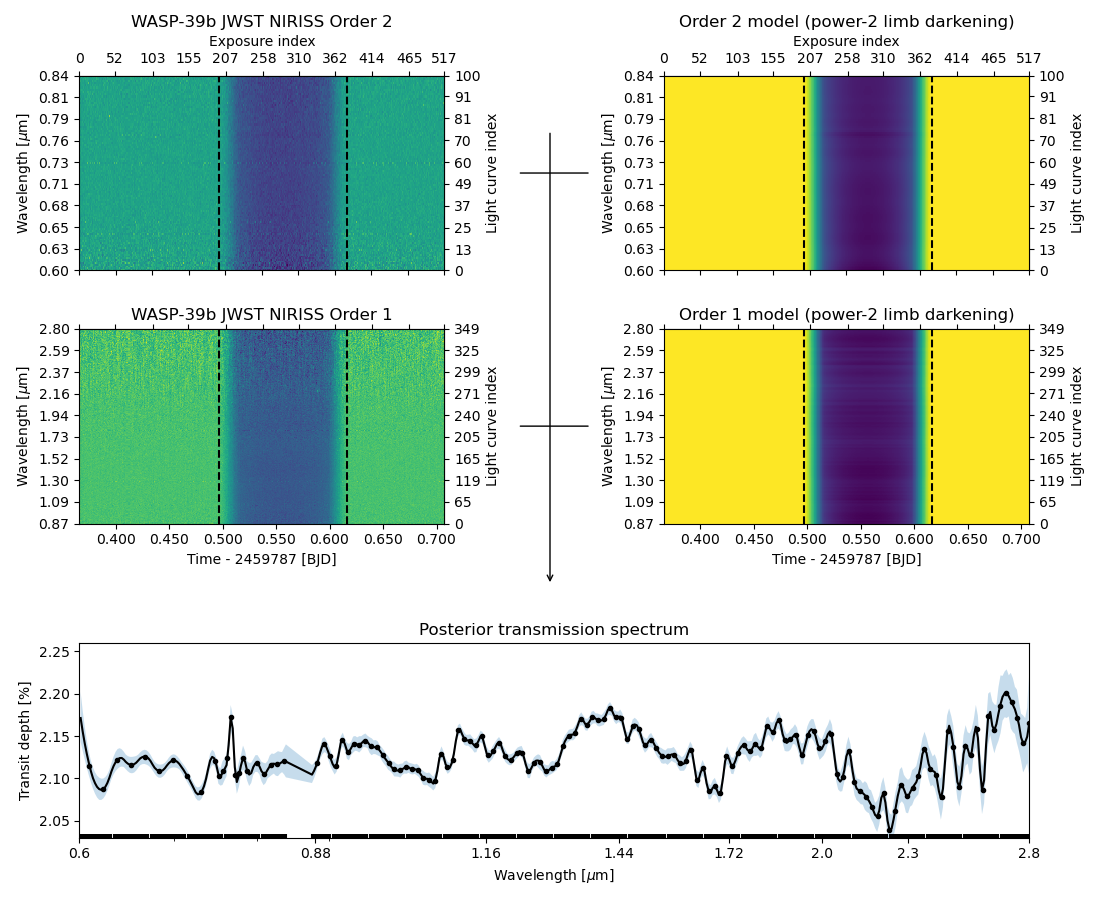
Analyse multiple instruments and epochs in a single self-consistent model.
Decouple data resolution from transmission spectrum resolution.
Model spot-crossing events and the transit light source effect.
Fit transit centres per epoch to account for TTVs.
Account for instrumental and astrophysical systematics.
Account for additive offsets between datasets.
Save and restore complete analyses as self-contained FITS files.
A custom likelihood function for atmospheric retrieval.
Documentation#
Getting Started
- Installation
- Tutorials
- Tutorial 1: The (Not So) Short Introduction to ExoIris
- Tutorial 2: Increasing the radius ratio knot resolution
- Tutorial 3: Increasing the data resolution
- Tutorial 4: Gaussian Process noise model
- Tutorial 5: Using the LDTk limb darkening model
- Tutorial 6: Modeling Spot Crossings During Transits
- Tutorial 7: The Transit Light Source Effect (TLSE)
- Appendix: Using the full data resolution
API Documentation
Support#
If you experience any difficulties with ExoIris, please submit an issue on the ExoIris GitHub repository. You are also encouraged to share suggestions or feature requests either through the same method or by reaching out to the authors directly.
License#
ExoIris is licensed under the GPLv3 license.